The stress and tinnitus link: how QuietTone takes a calm-first approach

Updated September 2026 · reviewed by the QuietTone Research Team. We are an independent information resource, not a medical provider, and this article is educational rather than medical advice.
The stress and tinnitus link is the well-documented tendency for stress, anxiety and poor sleep to make ear ringing feel louder — while that same ringing feeds back and adds to your stress. It is a two-way loop, not a simple cause and effect, and understanding it is the first step to calming it. That calm-first idea is exactly why QuietTone pairs steady calming botanicals with everyday nutrients, rather than promising to switch the sound off.
Does stress cause tinnitus, and can calm help? An honest, plain-language summary.
- The short answer
- Stress is not proven to cause tinnitus by itself, but it is one of the most consistent factors that make existing ear ringing feel louder and harder to ignore.
- The loop
- Stress raises the brain's alertness to internal signals, ringing becomes more noticeable, that noise adds stress — and around it goes.
- Why calm helps
- Calming habits rarely silence tinnitus, but they help you tune it out, so quiet moments feel quieter.
- Where QuietTone fits
- It supports a calm-first routine with calming botanicals plus vitamins and minerals — it is not a treatment for tinnitus or any condition.
If quiet rooms feel loud when you are wound up, you are not imagining it. Below: what the link is, what the evidence shows, and where a botanical formula like QuietTone plays a supporting role.
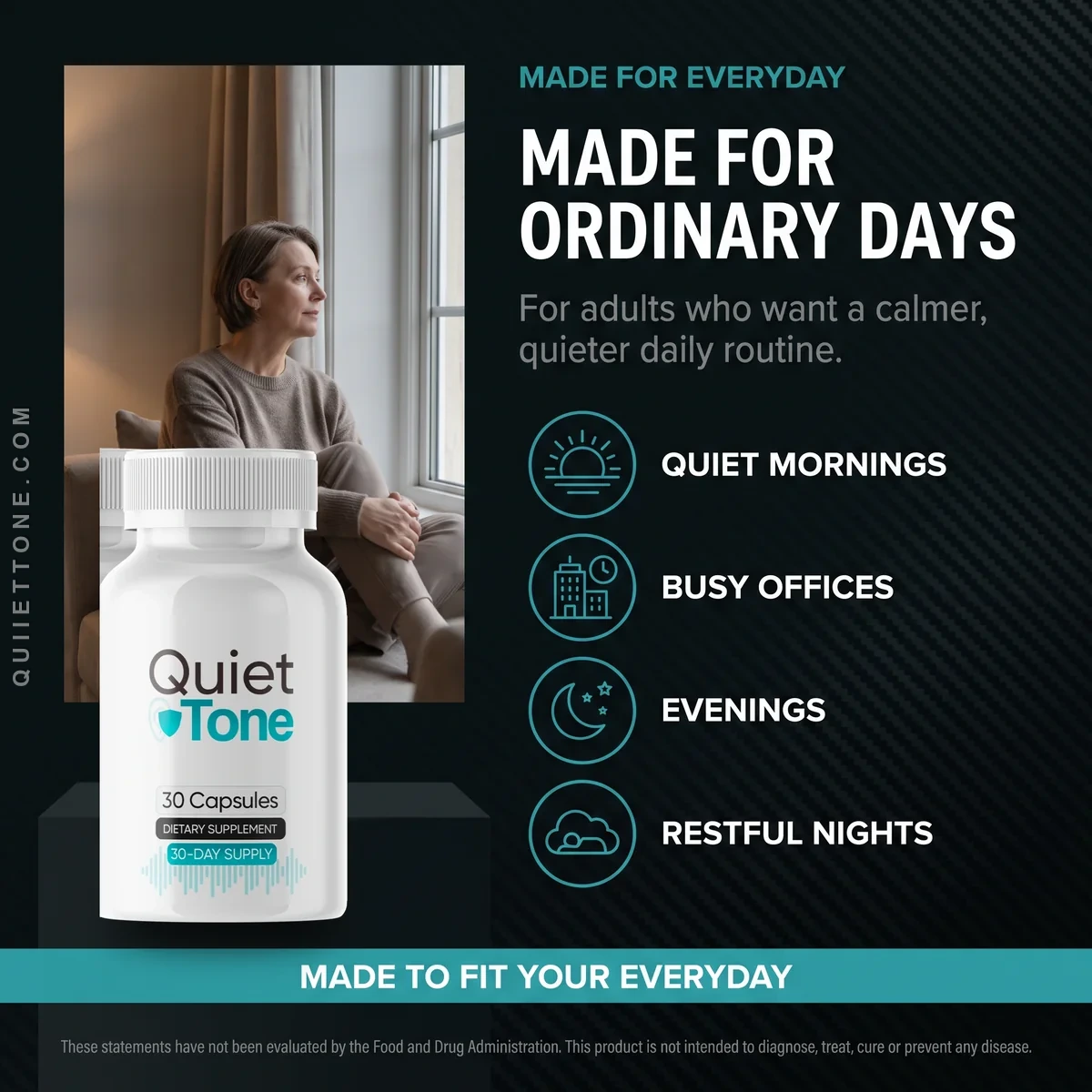
What is the stress and tinnitus link?
The stress and tinnitus link describes how psychological stress and the perception of ear ringing rise and fall together. Tinnitus is hearing sound — ringing, buzzing, hissing or humming — with no external source, and for many people its loudness is not fixed: on calm days it fades; on tense, sleep-short days it pushes to the front of attention.
Health bodies are careful with the wording, and so are we: stress is described as a factor that influences tinnitus, not a proven cause of it. Many things can be involved in why ear ringing appears — noise exposure, earwax, some medications, age-related changes. What the research consistently shows is that stress and anxiety shape how bothersome and how loud that ringing feels day to day.
Does stress cause tinnitus, or just make it louder?
For most people, stress does not create tinnitus out of nothing — it turns up the volume on ringing that is already there. That reframes the goal from making the sound vanish to settling the system that amplifies it. Researchers describe a bidirectional relationship: stress makes tinnitus feel worse, and intrusive tinnitus is itself stressful, so each side reinforces the other. A 2025 systematic review and meta-analysis in the American Journal of Otolaryngology found a consistent correlation between tinnitus and mental-health measures such as anxiety and depression (Jiang 2025, PMID 40088765).
How does the body's stress response reach the ears?
When you feel stressed, your body shifts into higher alert, releasing cortisol and adrenaline and putting the nervous system on guard. In that state the brain grows more sensitive to internal signals and less able to filter out background noise. The hearing pathway is wired into the same alerting networks that handle threat, so a stressed brain monitors ear ringing more closely.
Why does ear ringing feel worse after a bad day?
After a demanding day three things stack up: stress hormones are elevated, attention is frayed, and sleep is about to be shorter. Each independently makes tinnitus more noticeable, and together they can turn a faint hiss into the loudest thing in the room. It is also why ringing seems worst in bed, once the world goes quiet.

What does the research actually say about stress and ear ringing?
The honest summary is that the evidence links stress to how tinnitus is perceived, while stopping short of proving that any habit or supplement removes it. Here is a plain-language map of where the evidence is stronger and weaker.
| Claim | What the evidence suggests | Confidence |
|---|---|---|
| Stress makes tinnitus feel louder | Consistently associated with more bothersome ear ringing. | Reasonably strong (association) |
| Tinnitus increases stress | Intrusive ringing is itself a recognised source of distress, completing the loop. | Reasonably strong (association) |
| Poor sleep worsens perceived ringing | Short or broken sleep is linked with next-day sensitivity. | Moderate |
| Relaxation lowers tinnitus distress | Used to reduce how bothersome tinnitus feels, not to silence it. | Moderate |
| Any supplement removes tinnitus | No supplement is an established treatment; claims otherwise are not supported. | Not supported |
The strongest, most useful finding is the connection itself, because the stress side of the loop is the side you can most readily work on. For the sound itself, see what causes ringing in the ears.
See the exact calming blend in QuietTone →
Why does QuietTone take a calm-first approach?
QuietTone is built on a simple idea: if stress amplifies ear ringing, supporting everyday calm is the most sensible place for a supplement to help. It does not claim to target the ringing directly — that would be a treatment claim no supplement can honestly make. Instead it aims at the modifiable side of the loop — tension, wired-but-tired evenings, restless sleep — with ingredients traditionally linked to relaxation, in one once-daily capsule.
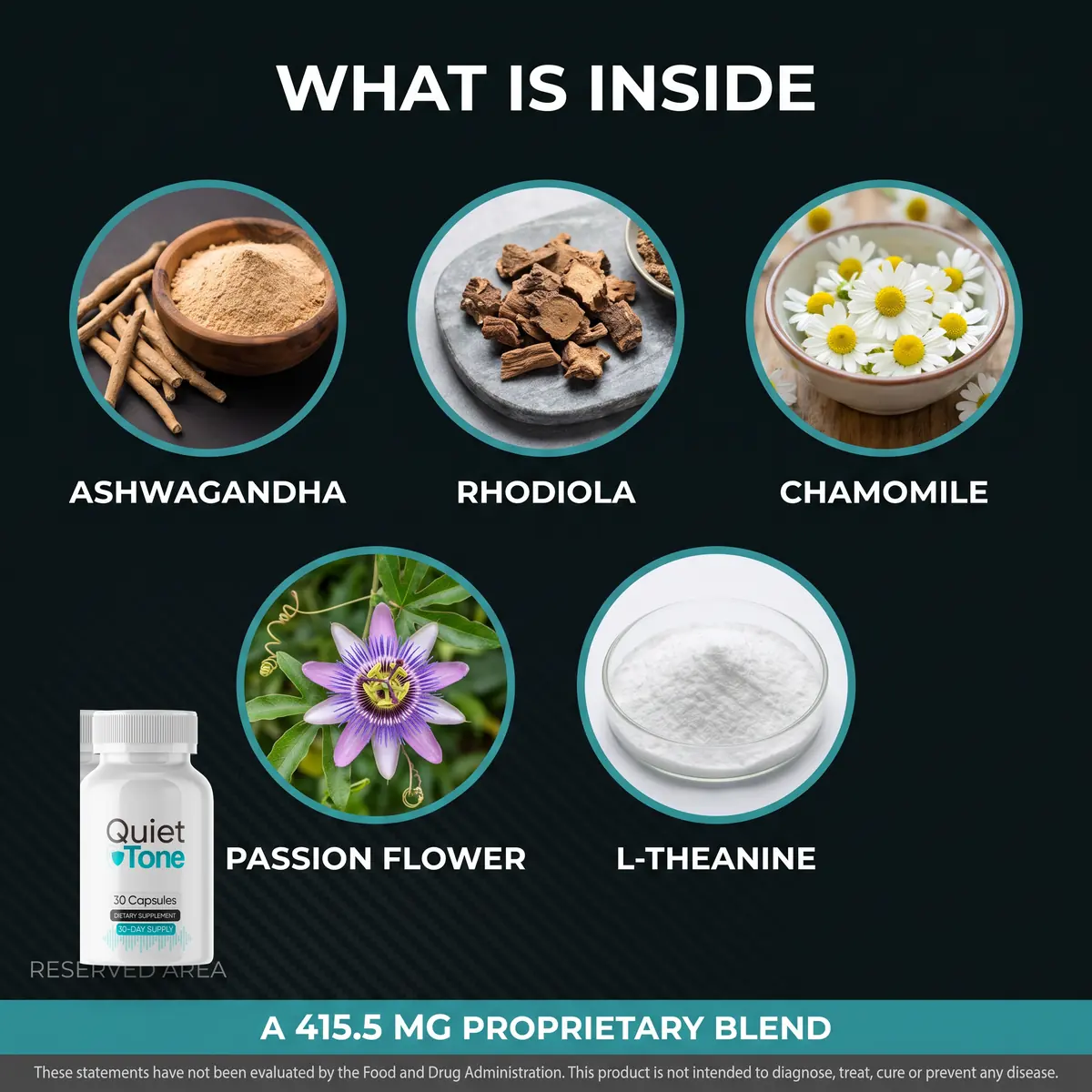
The formula pairs nine vitamins and minerals with a 415.5 mg botanical blend of ashwagandha, rhodiola, chamomile, lemon balm, GABA and L-theanine — each with a long history in wind-down and stress-resilience traditions (see the deeper dives on ashwagandha in QuietTone and L-theanine in QuietTone). Combining them makes one daily step, not a cabinet of pills.

Aim at the calm side of the loop
QuietTone is a once-daily capsule pairing nine vitamins and minerals with a 415.5 mg calming botanical blend. The six-bottle bundle is the best value at $49 per bottle, with free U.S. shipping and a 60-day guarantee.
Check today's QuietTone pricing — from $49/bottleWhich calming nutrients are part of the conversation?
The nutrients most often discussed alongside calm and the stress-tinnitus loop are those tied to normal nervous-system function and traditional relaxation, not to curing ear ringing. Several of the best-known, described in general terms below, appear in QuietTone; none is a treatment for any condition.
| Ingredient | Category | Traditional / general role |
|---|---|---|
| Magnesium | Essential mineral | Contributes to normal nervous-system function and normal psychological function. |
| Ashwagandha | Adaptogen | An Ayurvedic herb traditionally used to support calm and everyday stress resilience. |
| L-theanine | Amino acid | Found in tea; associated with a relaxed-but-alert state without drowsiness. |
| Chamomile & lemon balm | Calming botanicals | Classic wind-down herbs used for generations to support relaxation and restful evenings. |
| Rhodiola | Adaptogen | Traditionally used to help the body cope with everyday stress and fatigue. |
| B-complex vitamins | Energy metabolism | Contribute to normal energy-yielding metabolism and the reduction of tiredness and fatigue. |
Our roundup of the best nutrients for hearing and calm shows how these fit together; the homepage carries the full ingredients section.
How can you calm the stress-tinnitus loop day to day?
The most effective plan works the stress side of the loop with small, repeatable habits rather than one dramatic fix. The habits that calm your nervous system are the same ones that make quiet moments feel quieter. Stack these one at a time:
- Breathe slowly when it spikes. A few minutes of long, slow exhales signals the nervous system to stand down.
- Protect your sleep. Seven to nine steady hours blunts next-day sensitivity; a screen-free wind-down helps the ringing recede.
- Add gentle sound at night. A fan or soft background noise gives the brain something else to hear, so silence does not spotlight the ringing.
- Move most days. Twenty minutes of walking supports healthy circulation and relieves stress.
- Mind stimulants. Notice how caffeine and alcohol affect your own ears and sleep, and adjust the timing.
- Anchor a calm-first supplement. If you use one, take it at the same time daily — for QuietTone, one capsule with water before a meal.
Our guide on how to calm a racing mind at night goes deeper on the evening routine.

When should you see a doctor about ear ringing?
A calm-first routine supports everyday wellness; it does not diagnose or treat anything, so some situations call for professional care first. Speak with your doctor if your tinnitus is sudden, one-sided, pulsing in time with your heartbeat, or paired with hearing loss, dizziness, ear pain or discharge — and before adding any supplement if you are pregnant or nursing, under 18, take medication, or have a diagnosed condition. Ringing that is worsening or affecting sleep deserves a proper evaluation; the calm habits above sit alongside that care, never in place of it.
Frequently asked questions
Does stress cause tinnitus?
Stress is not proven to cause tinnitus on its own, but it is one of the most consistently reported factors that make existing ear ringing more noticeable and more bothersome. Research groups describe stress and tinnitus as closely linked in a two-way loop rather than a simple cause and effect.
Why does my ear ringing get louder when I am anxious?
When you are anxious your nervous system is on higher alert, which can turn up the brain's attention to internal signals like ear ringing. The sound itself may not have changed, but a stressed brain monitors it more closely, so it feels louder and harder to ignore.
Can calming down actually make tinnitus quieter?
For many people, calming habits do not silence tinnitus but make it easier to tune out, so quiet moments feel quieter. Steady sleep, slow breathing and lower daily stress are the levers most often linked with a calmer perception of ear noise, and results vary from person to person.
What is the stress and tinnitus link in simple terms?
The stress and tinnitus link is the well-documented tendency for stress, anxiety and poor sleep to make ear ringing feel louder, while that ringing in turn adds to stress. It is a feedback loop, which is why calming the loop is a sensible everyday goal.
Does QuietTone stop tinnitus?
No. QuietTone is a dietary supplement, not a treatment for tinnitus or any medical condition, and it is not intended to diagnose, treat, cure or prevent any disease. It pairs calming botanicals with vitamins and minerals to support a calm-first daily routine, which is where its role sits.
How long before a calm-first routine helps?
Simple stress-lowering steps such as slow breathing can help the same day, while sleep and stress routines usually settle over several weeks. Calming botanicals build their support gradually over weeks to a few months, and individual results vary.
See the exact dose in QuietTone — risk-free for 60 days →
QuietTone is a dietary supplement, not a treatment for any medical condition. These statements have not been evaluated by the Food and Drug Administration. This product is not intended to diagnose, treat, cure or prevent any disease. Always consult a qualified healthcare professional about your individual needs.
References & further reading
- National Institute on Deafness and Other Communication Disorders (NIDCD). Tinnitus. nidcd.nih.gov/health/tinnitus
- National Center for Complementary and Integrative Health (NCCIH). Ashwagandha. nccih.nih.gov/health/ashwagandha
- Mayo Clinic. Tinnitus — Symptoms and causes. mayoclinic.org/diseases-conditions/tinnitus
- Jiang Y, et al. Systematic review and meta-analysis of the correlation between tinnitus and mental health. American Journal of Otolaryngology, 2025. PMID 40088765
- National Institutes of Health, Office of Dietary Supplements. Magnesium — Fact Sheet for Health Professionals. ods.od.nih.gov/factsheets/Magnesium-HealthProfessional
- Examine.com. L-Theanine — evidence-based summary. examine.com/supplements/theanine
These references describe the ingredients and habits in general terms and do not constitute evidence that any product treats, cures or prevents any condition.
Keep reading: how to quiet ringing ears naturally · how to support healthy hearing naturally · back to the QuietTone blog · homepage.