Rhodiola for stress and hearing: the role of rhodiola crenulata in QuietTone

Updated September 2026 · reviewed by the QuietTone Research Team. We are an independent information resource, not a medical provider, and this article is educational rather than medical advice.
Rhodiola crenulata is a hardy high-altitude adaptogen traditionally used to support steady energy and everyday stress resilience, and in QuietTone it plays a supporting role alongside the calming botanicals rather than acting on the ear directly. Its job in a calm-first hearing formula is indirect but meaningful: help the body cope with day-to-day demands so tiredness and tension are less likely to make quiet moments feel loud.
Why rhodiola earns a place in a calm-and-hearing blend, in one honest paragraph.
- What it is
- A cold-climate root, Rhodiola crenulata, classed as an adaptogen — a plant traditionally used to help the body adapt to stress and fatigue.
- Its role in QuietTone
- Steady, non-jittery energy and stress resilience, so a tired, wired baseline is less likely to amplify background ear noise.
- Not a stimulant
- Unlike caffeine, rhodiola is associated with calm energy rather than a spike-and-crash, which is why it pairs well with chamomile and L-theanine.
- Honest limits
- Rhodiola does not act on the ear and is not a treatment for tinnitus or hearing loss. The evidence is for stress, mood and fatigue, not the ear itself.
Rhodiola is one of the more misunderstood names on a supplement label, so this guide keeps the claims tight and the evidence in view. Below we cover what rhodiola crenulata actually is, why an adaptogen belongs in a hearing-and-calm blend, how it differs from its better-studied cousin rhodiola rosea, and exactly where it sits in the QuietTone formula.
What is rhodiola crenulata, and why is it called an adaptogen?
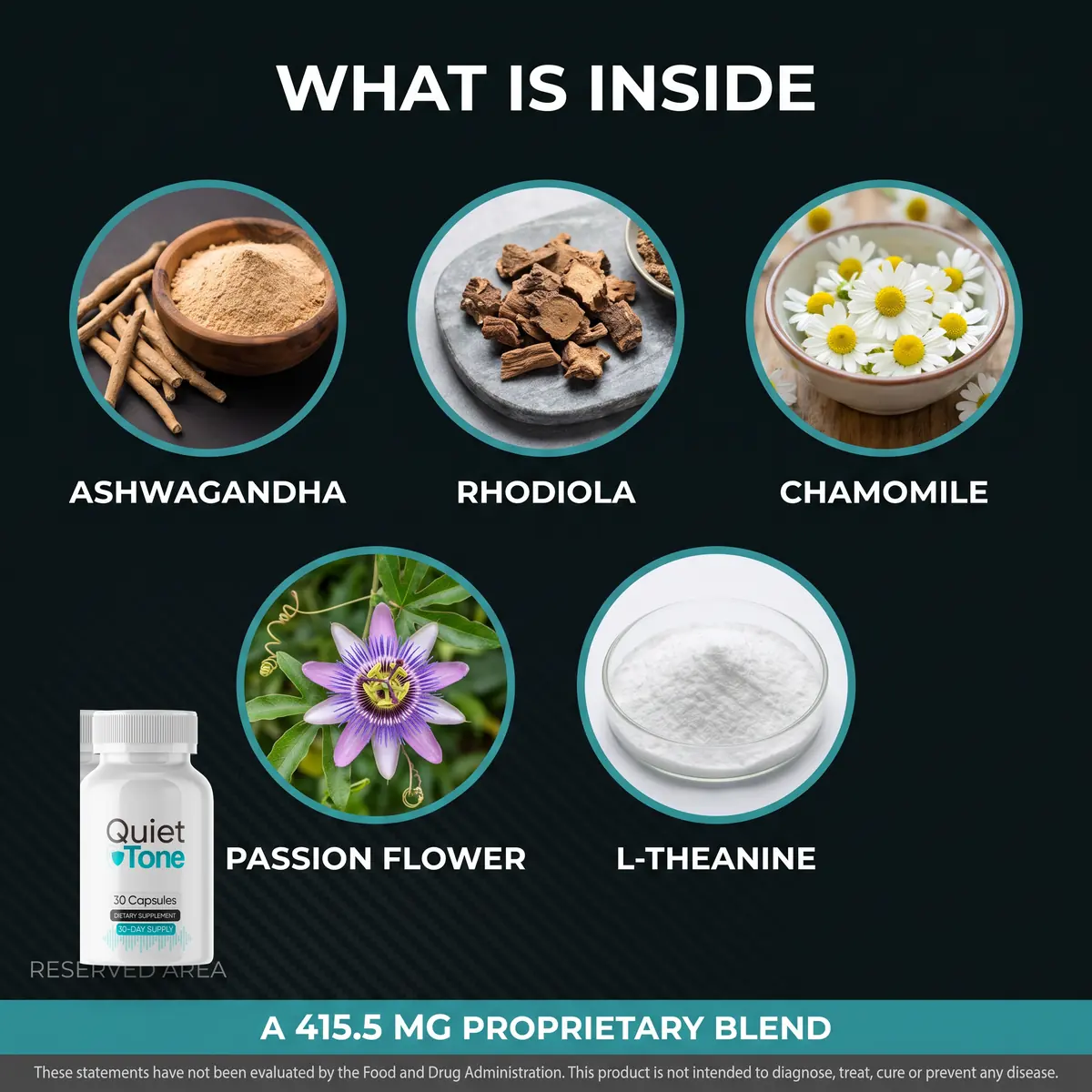
Rhodiola crenulata is a succulent, golden-flowered root that grows on the wind-scoured slopes of the Himalayas and the Tibetan plateau, where it survives thin air, cold and relentless UV. That toughness is the point: the plant makes a family of protective compounds — chiefly salidroside and the rosavins — that researchers link to its adaptogenic reputation. An adaptogen, in the classic definition, is a substance traditionally used to help the body resist and recover from stress without pushing it toward either over-stimulation or sedation. Rhodiola has been used this way for centuries in Tibetan, Scandinavian and Russian folk medicine. The general idea behind that balancing action is explained in how adaptogens work.
Where does rhodiola crenulata come from?
Rhodiola crenulata is the species most prized in Tibetan and Himalayan tradition, harvested above 4,000 metres and known locally as a “plateau ginseng.” In a modern capsule that heritage is standardised and combined with complementary herbs, so the root you might once have simmered into a bitter mountain tea now arrives as a measured part of a daily blend.
How does rhodiola relate to hearing support?
Rhodiola does not act on the ear, the cochlea or the auditory nerve, and it is important to say so plainly. Its connection to hearing wellness is entirely indirect and runs through stress. For many people, ringing, buzzing or a general sense of ear “busyness” feels worse on days that are stressful or exhausting — the sound has not changed, but a tired, over-clocked nervous system pays more attention to it. This is why a calm-first formula treats the whole picture: quiet the stress response, steady the energy, and the quiet moments stand a better chance of feeling quiet.
Rhodiola's contribution is stress resilience and steady energy. By supporting the body's day-to-day adaptation to demand, it aims to keep you off the frazzled, depleted baseline that tends to make ear noise more noticeable. It complements — never replaces — the direct calmers in the blend, and is never a substitute for medical care.
What does the research actually say about rhodiola?
The honest summary is that rhodiola's evidence is promising for stress and fatigue and thinner everywhere else. Most clinical work has studied rhodiola rosea rather than crenulata, focusing on mental fatigue, stress symptoms and low mood, not hearing. Several small trials report that rhodiola extracts may help people feel less fatigued and better able to cope with exhaustion, but reviewers note that study sizes are modest and quality is mixed. There is no credible evidence that rhodiola treats tinnitus, restores hearing, or reverses any ear condition, and this article makes no such claim. What the clinical literature does describe is encouraging but limited evidence for stress-related symptoms, summarised in a 2022 review in Molecules (Ivanova Stojcheva 2022, PMID 35745023).
| Traditional use of rhodiola | What the evidence base looks like | How we frame it |
|---|---|---|
| Everyday stress resilience | Small human trials and reviews on rhodiola rosea; encouraging but limited | Reasonable supporting rationale |
| Mental & physical fatigue | Some randomised trials suggest reduced fatigue scores | Promising, not conclusive |
| Steady, non-jittery energy | Long traditional use; mechanistic and small-trial support | Traditional-use framing |
| Hearing or tinnitus | No direct evidence | We make no hearing claim |
In short, rhodiola belongs in QuietTone for the reason it has belonged in a mountaineer's pouch for centuries: steadier energy and stress resilience — the levers that influence how loud a quiet room feels. For the wider nutrient picture, see our guide to the best nutrients for hearing and calm.
See the exact dose in QuietTone →
Rhodiola crenulata vs rhodiola rosea: what is the difference?
Rhodiola crenulata and rhodiola rosea are two species in the same genus, both used as adaptogens but with different research histories. Rhodiola rosea is the name most often cited in Western studies, while rhodiola crenulata is the plateau species at the heart of Tibetan practice. They contain the same headline markers — salidroside and rosavins — in different proportions, and crenulata is often noted for a higher salidroside content. The practical takeaway is simple: both are legitimate adaptogenic rhodiolas, and a formula may choose one for its tradition, compound profile or sourcing.
| Feature | Rhodiola crenulata | Rhodiola rosea |
|---|---|---|
| Native range | Himalaya & Tibetan plateau | Arctic Europe, Asia & North America |
| Tradition | Tibetan / Himalayan medicine | Scandinavian & Russian folk use |
| Best-known compounds | Salidroside (often higher), tyrosol | Rosavins & salidroside |
| Western clinical research | More limited | Larger body of trials |
| Typical use | Energy & stress resilience blends | Fatigue & mood studies |

Rhodiola, already measured for you
QuietTone pairs rhodiola crenulata with ashwagandha, chamomile, lemon balm, GABA and L-theanine in one daily capsule — no measuring bitter root tea. The six-bottle bundle is the best value at $49 per bottle, with free U.S. shipping and a 60-day guarantee.
Check today's QuietTone pricing — from $49/bottleHow does rhodiola fit the calm-first blend in QuietTone?
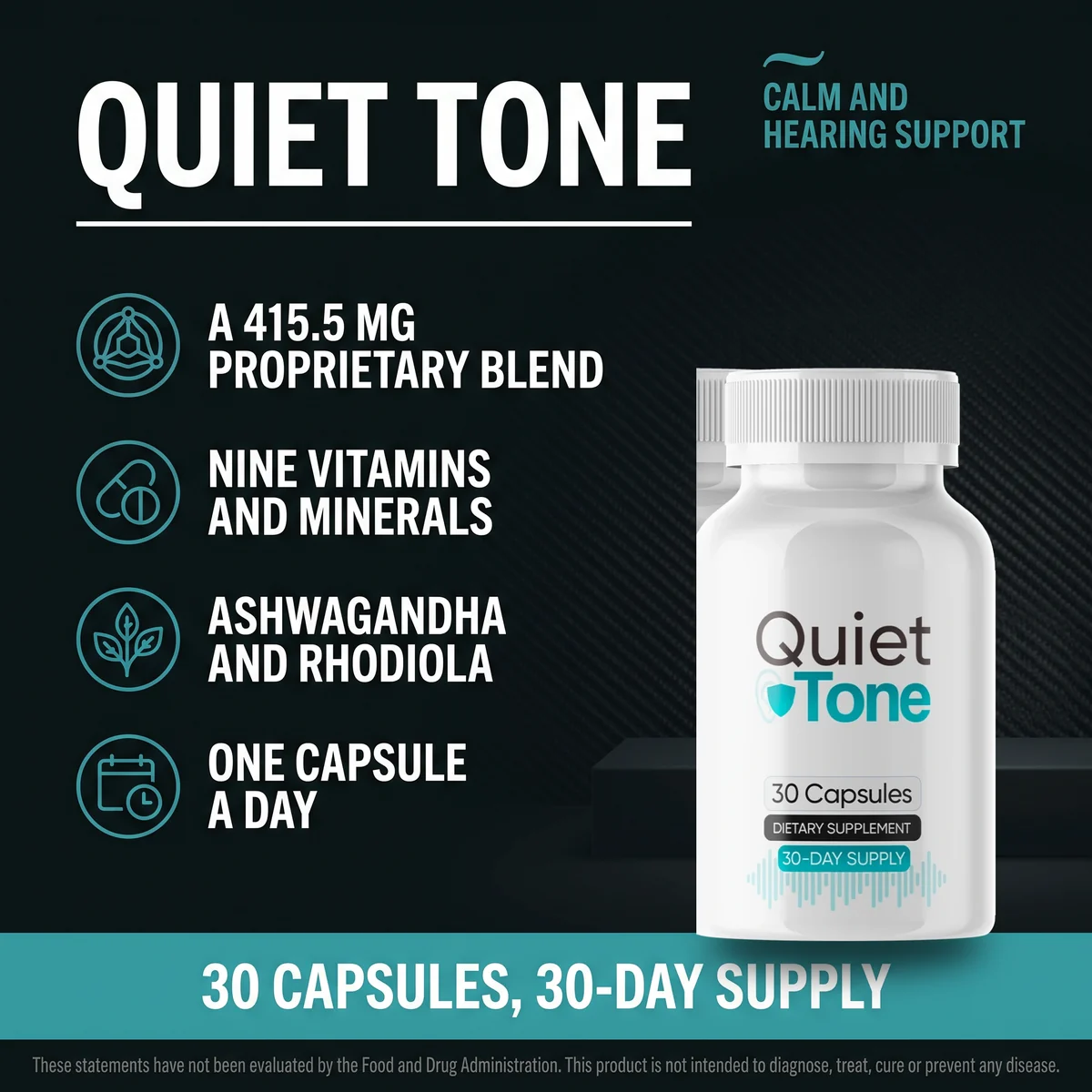
In QuietTone, rhodiola is the “steady energy” strand woven through a formula whose centre of gravity is calm. Ashwagandha and rhodiola are the two adaptogens; chamomile, lemon balm, GABA and L-theanine are the direct calmers; and nine vitamins and minerals round out the base. The intent is a blend that settles the nervous system without leaving you flat — enough steadiness for a demanding day, enough calm to let the evening wind down.
Why pair an energising adaptogen with calming herbs?
Pairing rhodiola with L-theanine and chamomile is a way of avoiding the two failure modes of a wellness capsule: too sedating to use by day, or too stimulating to use at all. Rhodiola contributes resilience and clear-headed energy; L-theanine is associated with relaxed focus; chamomile and lemon balm lean toward wind-down. Together they aim for a smooth, level baseline rather than a peak. This is also why rhodiola is not a caffeine substitute — there is no jolt to chase and no crash to manage.
How much rhodiola is in QuietTone, and how should you take it?
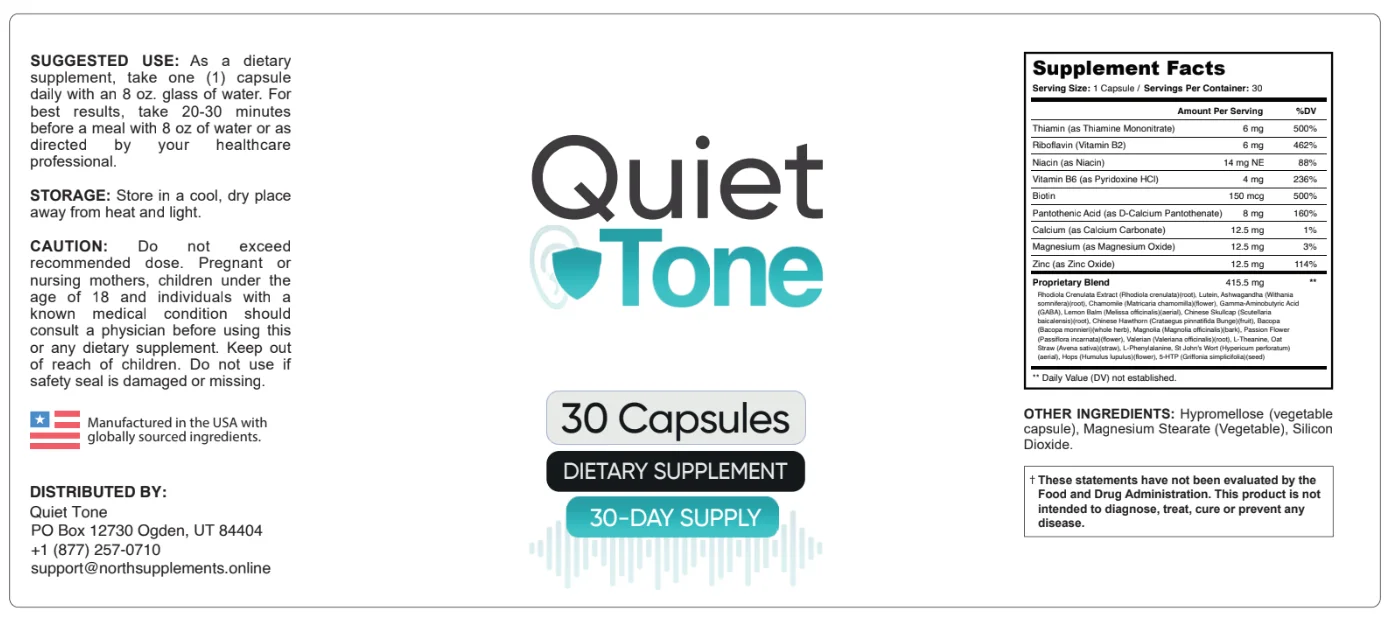
Rhodiola crenulata root is one part of QuietTone's 415.5 mg proprietary botanical blend, so the label lists the blend total rather than a per-ingredient figure. That is standard for a proprietary blend, and it means the exact rhodiola dose is not disclosed; if a precise, isolated rhodiola dose is your priority, a single-ingredient extract may suit you better — an honest trade-off worth naming. For everyone else, QuietTone's appeal is the opposite: one capsule combining rhodiola with complementary adaptogens and calmers, taken once a day with water, ideally before a meal and at a consistent time. Adaptogens reward consistency, so most people plan a multi-week run.
Who should be cautious with rhodiola?
Rhodiola is generally well tolerated in traditional use, but it is not for everyone, and a quick check with your doctor is wise before you start. Speak with a healthcare professional if you are pregnant or nursing, under 18, live with a diagnosed condition, or take prescription medication — including antidepressants, blood-pressure drugs or diabetes medicines — because adaptogens can interact. Stop and seek advice if you notice agitation or sleep disturbance, and always see your doctor for sudden hearing change, ear pain, dizziness, discharge or ringing in only one ear. Rhodiola supports a routine; it does not diagnose, treat, cure or prevent any disease.
Frequently asked questions
What is rhodiola crenulata used for?
Rhodiola crenulata is a hardy high-altitude adaptogen traditionally used to support steady energy, mental stamina and everyday stress resilience. In QuietTone it sits alongside calming botanicals to help the body cope with day-to-day demands, and it is not a treatment for any medical condition.
How does rhodiola relate to hearing support?
Rhodiola does not act on the ear directly. Its role in a hearing-and-calm formula is indirect: by supporting stress resilience and steady energy, it helps address the fatigue and tension that often make background ear noise feel more noticeable, so quiet moments have a better chance of feeling quiet.
What is the difference between rhodiola crenulata and rhodiola rosea?
Both are Arctic and mountain species in the same genus used as adaptogens. Rhodiola rosea has the larger body of Western clinical research, while rhodiola crenulata is the species prized in Tibetan and Himalayan tradition and is common in modern blends. They share the marker compounds salidroside and rosavins in differing proportions.
Is rhodiola a stimulant like caffeine?
No. Rhodiola is classed as an adaptogen rather than a stimulant. It does not deliver a caffeine-style spike and crash; instead it is traditionally associated with a calmer, steadier form of energy and focus, which is why it pairs comfortably with the calming botanicals in QuietTone.
How much rhodiola is in QuietTone?
Rhodiola crenulata root is one component of QuietTone's 415.5 mg proprietary botanical blend, alongside ashwagandha, chamomile, lemon balm, GABA and L-theanine. Because it is a proprietary blend, the exact per-ingredient milligram figure is not disclosed on the label; you can see the full panel in the supplement facts.
How long does rhodiola take to work?
Adaptogens are generally taken consistently rather than as a one-off. Most traditions and studies use daily doses over several weeks, so a multi-week routine is the usual expectation. Individual responses vary, and rhodiola supports a routine rather than delivering an instant effect.
See how rhodiola fits into QuietTone →
QuietTone is a dietary supplement, not a treatment for any medical condition. These statements have not been evaluated by the Food and Drug Administration. This product is not intended to diagnose, treat, cure or prevent any disease. Always consult a qualified healthcare professional about your individual needs.
References & further reading
- National Center for Complementary and Integrative Health (NCCIH). Rhodiola. nccih.nih.gov/health/rhodiola
- Examine.com. Rhodiola Rosea — evidence-based summary. examine.com/supplements/rhodiola-rosea
- Ivanova Stojcheva E, et al. The effectiveness of Rhodiola rosea L. preparations in alleviating various aspects of life-stress symptoms and stress-induced conditions. Molecules, 2022. PMID 35745023
- Ishaque S, et al. Rhodiola rosea for physical and mental fatigue: a systematic review. BMC Complementary and Alternative Medicine (via PubMed Central). ncbi.nlm.nih.gov/pmc/articles/PMC3541197
- National Center for Complementary and Integrative Health (NCCIH). Adaptogens — what the science says. nccih.nih.gov/health/herbsataglance
These references describe the ingredient in general terms and do not constitute evidence that any product treats, cures or prevents any condition.
Keep reading: what causes ringing in the ears · how to support healthy hearing naturally · the QuietTone review · back to the QuietTone blog.