GABA supplement for calm: how the amino acid works in QuietTone

Updated September 2026 · reviewed by the QuietTone Research Team. We are an independent information resource, not a medical provider, and this article is educational rather than medical advice.
A GABA supplement for calm supplies gamma-aminobutyric acid — the amino acid the body uses as its main calming, or inhibitory, messenger — to support a settled, relaxed baseline as part of a wind-down routine. In QuietTone, GABA is one carefully chosen thread woven through a wider calm-and-hearing blend, and this guide explains what it is, how it works, and where the evidence is strong versus still emerging.
What GABA is, and why it sits inside QuietTone's blend, in one place.
- What it is
- GABA (gamma-aminobutyric acid) is a naturally occurring amino acid and the nervous system's chief calming signal.
- Why it is used
- People take a GABA supplement for calm to support relaxation and an easier wind-down, not to treat any condition.
- What the evidence says
- Small studies link oral GABA with self-rated relaxation, but the research is early and scientists still debate how much reaches the brain.
- Where it fits in QuietTone
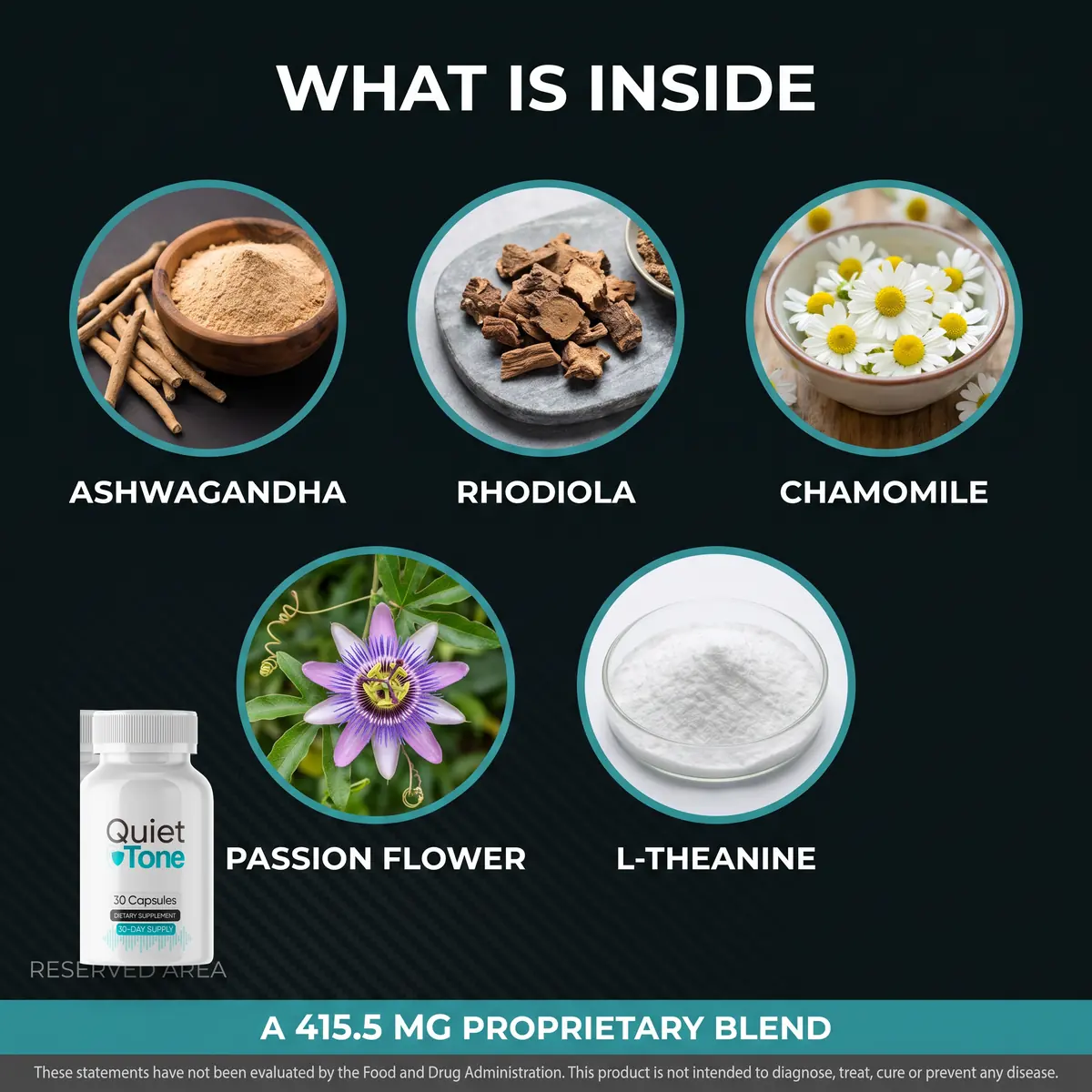
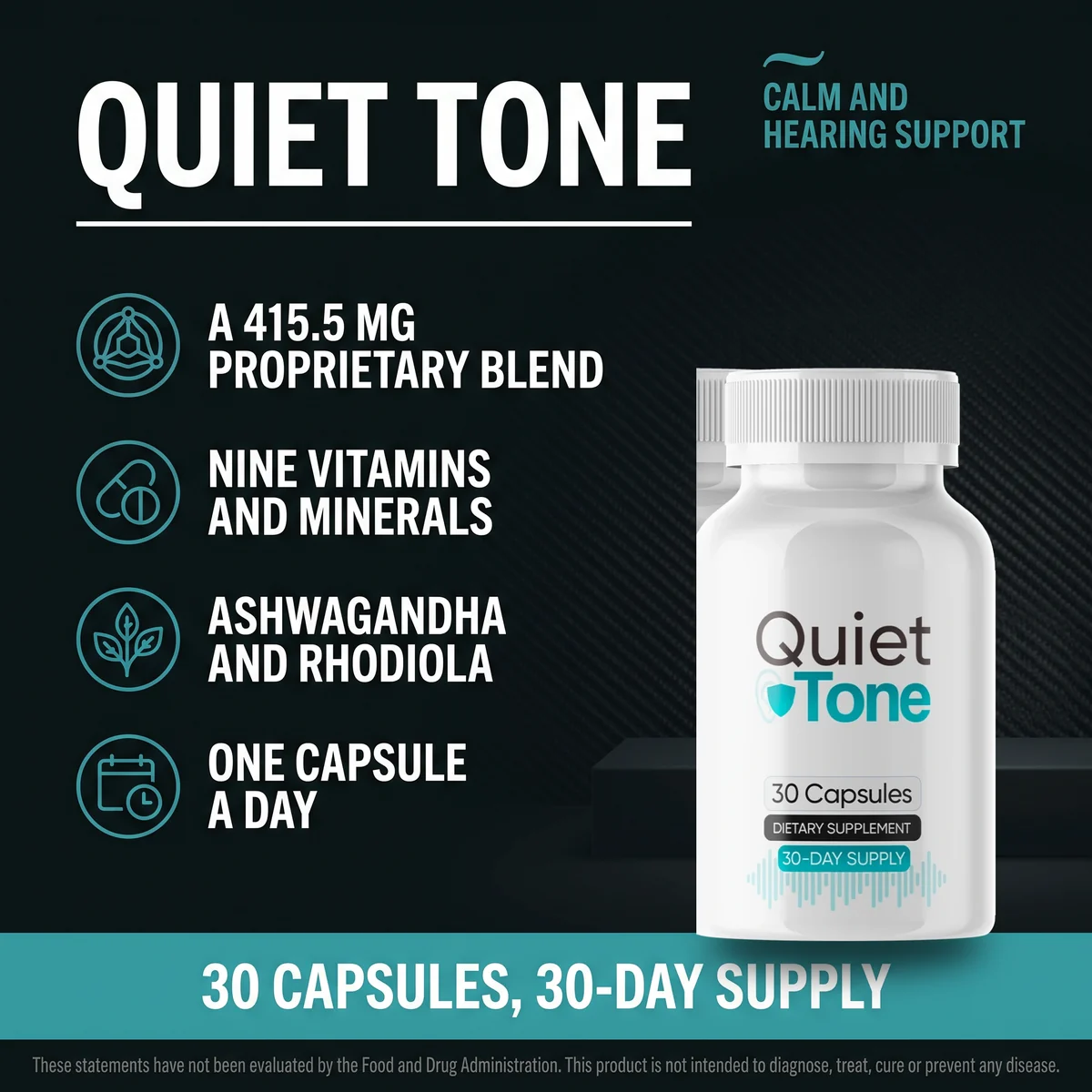
- GABA is one part of a 415.5 mg blend with L-theanine, ashwagandha, rhodiola, chamomile and lemon balm in a once-daily capsule.
Below we unpack the science in plain language, stay honest about its limits, and show exactly where GABA sits in QuietTone's once-daily approach to calm and hearing wellness.
What is GABA (gamma-aminobutyric acid)?
GABA, short for gamma-aminobutyric acid, is a naturally occurring amino acid that also serves as the body's primary calming, or inhibitory, neurotransmitter. In plain terms, if some nerve signals are the accelerator, GABA is the brake — the message that tells over-active nerve cells to ease off so the system can quieten. Your body makes it from another amino acid called glutamate, and it is also present in small amounts in certain fermented foods such as tempeh, kimchi and some teas. Because it is central to how the nervous system settles, it has become one of the most talked-about ingredients in the everyday-calm category.
Is GABA the same thing whether it is in the body or in a capsule?
Chemically, yes: the GABA molecule in a supplement is identical to the one your body produces. The interesting question is not what it is but where it goes. GABA made inside the brain acts locally, whereas GABA swallowed in a capsule has a longer journey and a debated destination — a distinction we return to below. The comparison shoppers most often want first is covered in L-theanine vs GABA.
Why is GABA in QuietTone's blend?
GABA appears in QuietTone because it represents the calming side of the nervous-system conversation, complementing ingredients that work through different routes. QuietTone was formulated around a simple idea: everyday calm and comfortable hearing tend to travel together, and a settled nervous system is friendlier to both. GABA earns its place as the amino acid most directly associated with the body's own quieting signal.
How does GABA pair with L-theanine and the botanicals?
GABA is rarely used alone, and QuietTone follows that logic. It is paired with L-theanine, an amino acid from tea leaves associated with relaxed alertness, and with traditional wind-down botanicals like chamomile and lemon balm. Alongside them sit the adaptogens ashwagandha and rhodiola, long used to support everyday stress resilience. The thinking is that a considered combination supports calm more gently than a large dose of a single compound. For the wider picture, our guide to the best nutrients for hearing and calm maps how these pieces fit.
See the exact dose in QuietTone →
How does GABA work for relaxation?
GABA works for relaxation by binding to specialised GABA receptors on nerve cells, which makes those cells less likely to fire and so dials down excess nervous-system activity. When neurons are firing in an over-excited pattern — the racing-mind feeling many people know at the end of a busy day — a calming signal helps restore balance. This is why GABA is described as inhibitory: its job is to say “enough,” letting tension in the system ease. That mechanism is well established for the GABA your brain makes itself; the open scientific question is how much of an oral dose contributes to it.
What is the blood-brain barrier debate?
The blood-brain barrier is a protective filter that controls which molecules pass from the bloodstream into the brain, and for years scientists assumed swallowed GABA could not cross it in meaningful amounts. Newer thinking is more nuanced. Some researchers propose that oral GABA may act partly through the enteric nervous system — the dense web of nerves in the gut sometimes called the “second brain” — and through the gut-brain axis, rather than by crossing directly into the brain. The honest summary is that the exact pathway is not settled, and anyone who tells you it is fully understood is overstating the science. A 2020 systematic review of oral GABA in Frontiers in Neuroscience reached the same verdict: limited evidence for stress and very limited evidence for sleep, mostly from small studies (Hepsomali 2020, PMID 33041752).
What does the evidence say about GABA supplements?
The evidence for oral GABA supplements is early, modest in size, and mixed in quality, which is exactly why an honest ingredient guide should say so. A handful of small human studies have reported that GABA is associated with self-rated relaxation, lower stress ratings during demanding tasks, or changes in brain-wave patterns linked with a calmer state. These findings are encouraging but preliminary: many trials are small, some are funded by ingredient makers, and results do not always replicate. The table below sorts the common claims by how much support currently exists.
| Claim about GABA | Evidence status | Honest reading |
|---|---|---|
| GABA is the body's main calming neurotransmitter | Well established | Textbook neuroscience; not in dispute. |
| Oral GABA is linked with self-rated relaxation | Preliminary | Some small studies suggest it; more and larger trials are needed. |
| GABA supports an easier wind-down for some people | Anecdotal & early | Commonly reported, individual and not guaranteed. |
| Oral GABA crosses the blood-brain barrier freely | Contested | Debated; a gut-brain route is one leading hypothesis. |
| GABA treats, cures or prevents any condition | Not supported | No — it is a supplement, not a medicine. |
In short, GABA has a rock-solid role inside the body and a promising but unfinished story as an oral supplement. That is a reasonable basis for including it in a calming routine, and not a basis for any medical claim.

GABA, without the guesswork of stacking pills
QuietTone pairs GABA with L-theanine, ashwagandha, rhodiola, chamomile and lemon balm in one once-daily capsule — a 415.5 mg blend plus nine vitamins and minerals. The six-bottle bundle is the best value at $49 per bottle, with free U.S. shipping and a 60-day guarantee.
Check today's QuietTone pricing — from $49/bottleHow much GABA is in QuietTone?
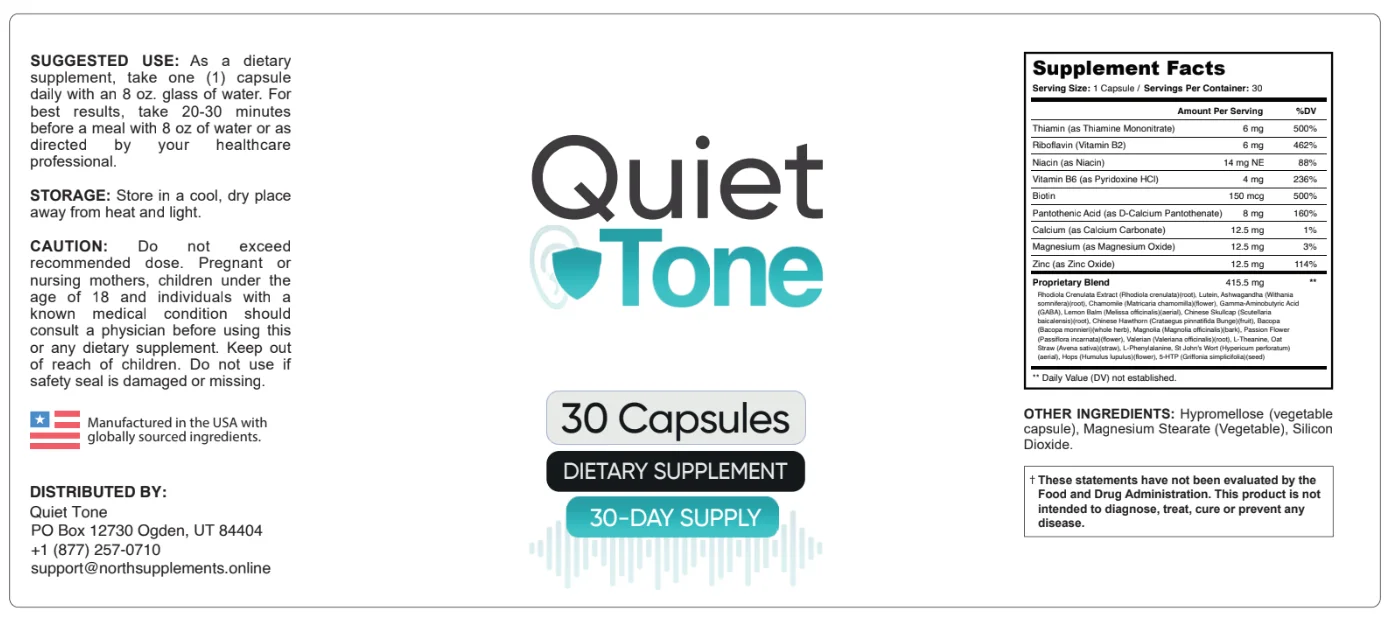
In QuietTone, GABA is one named component of a 415.5 mg proprietary blend rather than a standalone mega-dose, and the per-ingredient amounts are printed on the supplement facts panel. This reflects the formula's philosophy of balanced layering over single-ingredient extremes. The label lists GABA alongside L-theanine, ashwagandha, rhodiola, chamomile and lemon balm, plus a foundation of nine vitamins and minerals, all delivered in a single daily capsule you can take with water before a meal.
| Blend component | Type | Traditional / general role |
|---|---|---|
| GABA | Amino acid | The body's main calming messenger; used to support a settled, relaxed baseline. |
| L-theanine | Amino acid | From tea leaves; associated with relaxed, focused calm without heavy sedation. |
| Ashwagandha | Adaptogen | Ayurvedic herb traditionally used for everyday stress resilience. |
| Rhodiola | Adaptogen | Traditionally used to help the body cope with fatigue and demand. |
| Chamomile & lemon balm | Calming botanicals | Classic wind-down herbs used for generations to support relaxation. |
Because botanicals and amino acids tend to support the body gradually rather than overnight, most people keep a steady daily routine and choose a multi-month supply. You can compare the packages and pricing or read the full QuietTone review for the complete ingredient breakdown.
Who might consider a GABA supplement for calm?
A GABA supplement for calm is generally aimed at healthy adults who want gentle, everyday support for relaxation and an easier wind-down, not at treating any diagnosed problem. People often reach for one when the mind feels busy in the evening or simply as part of a considered bedtime routine. It is best thought of as one supporting habit among several — steady sleep, movement, daylight and calm rituals still do much of the work, as our guide to supporting healthy hearing naturally lays out.
Is GABA safe, and when should you check with a doctor?
GABA is generally well tolerated at supplement amounts, with only occasional mild reports such as drowsiness, a brief tingling sensation, or a slightly upset stomach. Even so, more is not better, and a supplement is not a substitute for medical care. Speak with your doctor before starting GABA or any calming supplement if you are pregnant or nursing, under 18, take prescription medication, or have a diagnosed health condition, so anything you add fits safely alongside your existing care.
Frequently asked questions
What is GABA?
GABA, or gamma-aminobutyric acid, is a naturally occurring amino acid that the body also uses as its main calming (inhibitory) messenger in the nervous system. It is the signal that helps quieten nerve activity so the system can settle.
Is GABA an amino acid?
Yes. GABA is a non-protein amino acid, meaning it is not used to build proteins but instead acts as a signalling molecule. It is made in the body from another amino acid, glutamate, and is also found in some fermented foods and in supplements like QuietTone.
Does a GABA supplement actually make you calm?
Some small studies report that oral GABA is associated with self-rated relaxation and lower stress markers, but the evidence is early and mixed, partly because researchers still debate how much oral GABA reaches the brain. Many people take it as part of a calming routine rather than as a proven treatment.
How much GABA is in QuietTone?
GABA is one component of QuietTone's 415.5 mg botanical and amino-acid blend, alongside ashwagandha, rhodiola, chamomile, lemon balm and L-theanine. The exact per-serving amount of each blend component is shown on the QuietTone supplement facts panel.
Is GABA safe to take daily?
GABA is generally well tolerated at the amounts used in supplements, and mild effects like drowsiness or a tingling sensation are occasionally reported. If you are pregnant or nursing, under 18, take medication or have a health condition, check with your doctor before adding any GABA supplement.
Can I take GABA with other calming ingredients?
GABA is frequently paired with L-theanine and calming botanicals such as chamomile and lemon balm, which is exactly how QuietTone combines them in one capsule. As with any supplement, tell your healthcare provider what you take so everything fits together safely.
See the exact GABA dose in QuietTone →
QuietTone is a dietary supplement, not a treatment for any medical condition. These statements have not been evaluated by the Food and Drug Administration. This product is not intended to diagnose, treat, cure or prevent any disease. Always consult a qualified healthcare professional about your individual needs.
References & further reading
- MedlinePlus / U.S. National Library of Medicine. GABA (gamma-aminobutyric acid). medlineplus.gov/druginfo/natural/464.html
- Examine.com. GABA — evidence-based summary. examine.com/supplements/gaba
- Hepsomali P, et al. Effects of oral gamma-aminobutyric acid (GABA) administration on stress and sleep in humans: a systematic review. Frontiers in Neuroscience, 2020. PMID 33041752
- Boonstra E, et al. Neurotransmitters as food supplements: the effects of GABA on brain and behavior. PubMed / U.S. National Library of Medicine. pubmed.ncbi.nlm.nih.gov/26500584
- Examine.com. L-Theanine — evidence-based summary. examine.com/supplements/theanine
- National Center for Complementary and Integrative Health (NCCIH). Ashwagandha. nccih.nih.gov/health/ashwagandha
These references describe the ingredients in general terms and do not constitute evidence that any product treats, cures or prevents any condition.
Keep reading: the best nutrients for hearing and calm · what causes ringing in the ears · back to the QuietTone blog · homepage.