Does ashwagandha really work? A QuietTone fact check

Updated September 2026 · reviewed by the QuietTone Research Team. We are an independent information resource, not a medical provider, and this article is educational rather than medical advice.
Ashwagandha does “really work” for a narrow, honest claim: standardised root-extract trials show modest, real reductions in everyday stress and improvements in sleep quality versus placebo. It does not work as a cure for any disease, the evidence is younger and thinner than the marketing suggests, and a dose hidden inside a proprietary blend tells you far less than a clear supplement facts panel does. This fact check sorts the traditional-use stories from what the research actually supports.
Does ashwagandha really work? An honest, evidence-weighted verdict in one place.
- The honest verdict
- Yes for modest, real stress and sleep support in trials; no for any claim that it treats, cures or prevents disease.
- Strongest evidence
- Self-reported stress and sleep quality, from several small randomised trials using standardised root extract.
- The studied dose
- Most positive trials used about 250–600 mg per day of standardised extract for six to twelve weeks.
- The blend caveat
- A proprietary blend gives one combined total, so you cannot confirm the exact ashwagandha amount — judge it by the total and transparency.
Ashwagandha (Withania somnifera) is one of the most hyped botanicals of the decade, and hype invites both overclaiming and knee-jerk dismissal. The useful position sits in the middle: a well-studied adaptogen with genuine but limited human data. Below we walk through where the claims come from and how a formula like QuietTone can present ashwagandha without overselling it.
Where does the “ashwagandha really works” claim come from?
The claim begins in tradition, not in the laboratory: ashwagandha has been used in Ayurvedic practice for more than two thousand years as a rasayana, or rejuvenating tonic, valued for calm, stamina and restful sleep. That heritage is real and worth respecting, but traditional use is a hypothesis, not proof. It tells us a plant has been used a certain way for a long time; it does not tell us how well it performs against a placebo in a controlled setting. Modern interest simply took that long history and put it to the test.
Is traditional use the same as evidence?
Traditional use and clinical evidence answer two different questions. Tradition answers “what have people used this for?” while a randomised trial answers “does it beat a dummy pill?” Many marketing pages blur the two, quoting centuries of Ayurvedic use as if it were trial data. An honest label keeps them separate, describing ashwagandha as a traditionally used herb while reserving outcome claims for what studies can actually back.
What does ashwagandha evidence actually show?
The strongest human evidence for ashwagandha is for lowering self-reported stress and improving sleep quality, seen in several small-to-medium randomised controlled trials using standardised root extracts. Reviews from the National Center for Complementary and Integrative Health and evidence summaries on Examine.com describe these findings as promising but constrained: study samples are usually small, trials rarely run beyond a few months, many are industry-funded, and results vary between extracts. In short, there is a real signal, but it is a modest one measured with soft, self-reported tools — not proof of a dramatic effect.
| Ashwagandha claim | What the human evidence looks like | Honest strength |
|---|---|---|
| Reduces everyday stress | Several small RCTs report lower perceived-stress scores versus placebo over 6–12 weeks. | Moderate |
| Improves sleep quality | Multiple trials and a small meta-analysis show better self-rated sleep, mostly in stressed adults. | Moderate |
| Supports a calm mood | Overlaps with stress data; measured by questionnaires, not clinical diagnosis. | Preliminary |
| Boosts strength or testosterone | A handful of small, often male-only trials; findings are inconsistent and easily overstated. | Weak / mixed |
| “Cures” anxiety or hearing issues | No adequate evidence; not a medical treatment for any condition. | Not supported |
Why is the evidence called “limited”?
“Limited” is not a euphemism for “useless” — it is a precise description of research maturity. Ashwagandha trials tend to enrol a few dozen people, run for a couple of months, rely on questionnaires rather than hard biomarkers, and use different extracts at different doses, which makes results hard to pool. The responsible reading is that ashwagandha shows a believable, modest benefit for calm and sleep in stressed adults, and that anyone promising more has left the evidence behind. The sleep half of that summary rests largely on a 2021 meta-analysis in PLoS ONE, which found a small overall effect that was bigger in people with diagnosed insomnia (Cheah 2021, PMID 34559859).
See the exact dose disclosed in QuietTone →
What does a proprietary-blend dose tell you — and not tell you?
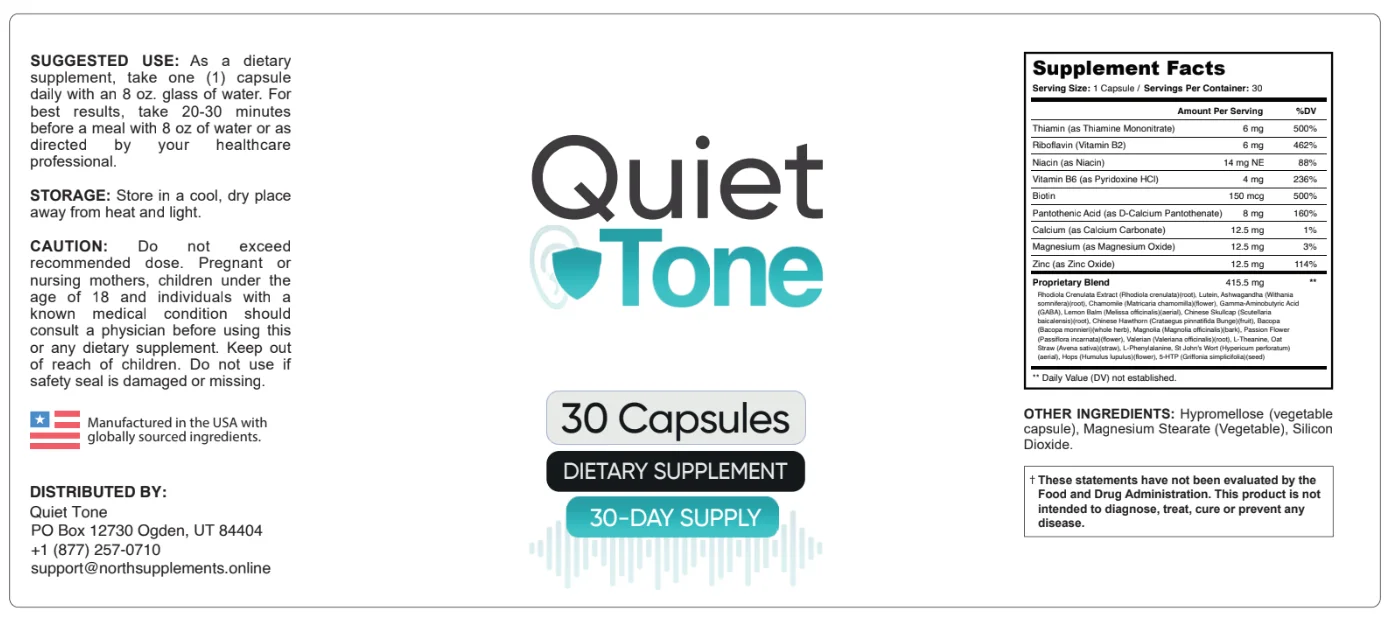
A proprietary blend lists several ingredients under one combined milligram total instead of naming the amount of each, which means you cannot confirm exactly how much ashwagandha you are getting. We unpack that format on its own terms in what a proprietary blend really means. Blends are legal and extremely common, and they are not automatically a red flag — but they do shift the burden onto you to read carefully. Because studied ashwagandha doses cluster around 250–600 mg per day of standardised extract, a blend total that is smaller than that, or that lists ashwagandha low in the ingredient order, may deliver less than the amount trials used.
| What you see on a label | What it does tell you | What it does not tell you |
|---|---|---|
| “Contains ashwagandha” | The ingredient is present. | Whether the amount matches any studied dose. |
| Proprietary blend total (e.g. 415.5 mg) | The combined weight of all blended ingredients. | The individual milligrams of each ingredient. |
| Ingredient order in the blend | Rough ranking by weight, largest first. | The exact gap between the first and last item. |
| “Standardised extract” | A consistent level of key compounds. | Nothing, unless the extract is actually named. |
The practical takeaway: judge a blend by its total size, the position of the ingredient you care about, and how openly the maker publishes its full panel. A brand that hides the panel and leans on folklore is asking for trust it has not earned; a brand that shows the numbers lets you decide for yourself.

See the exact dose in QuietTone
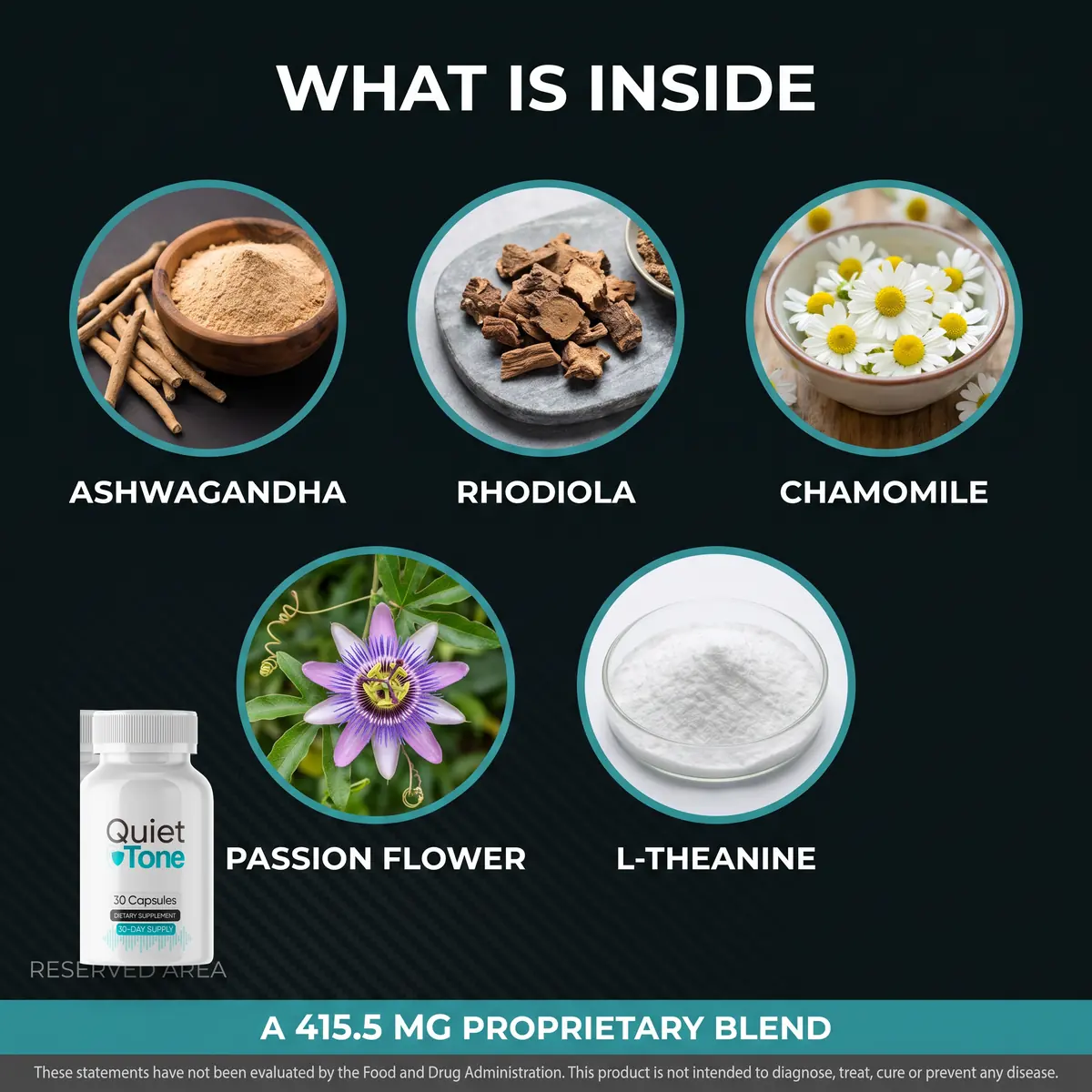
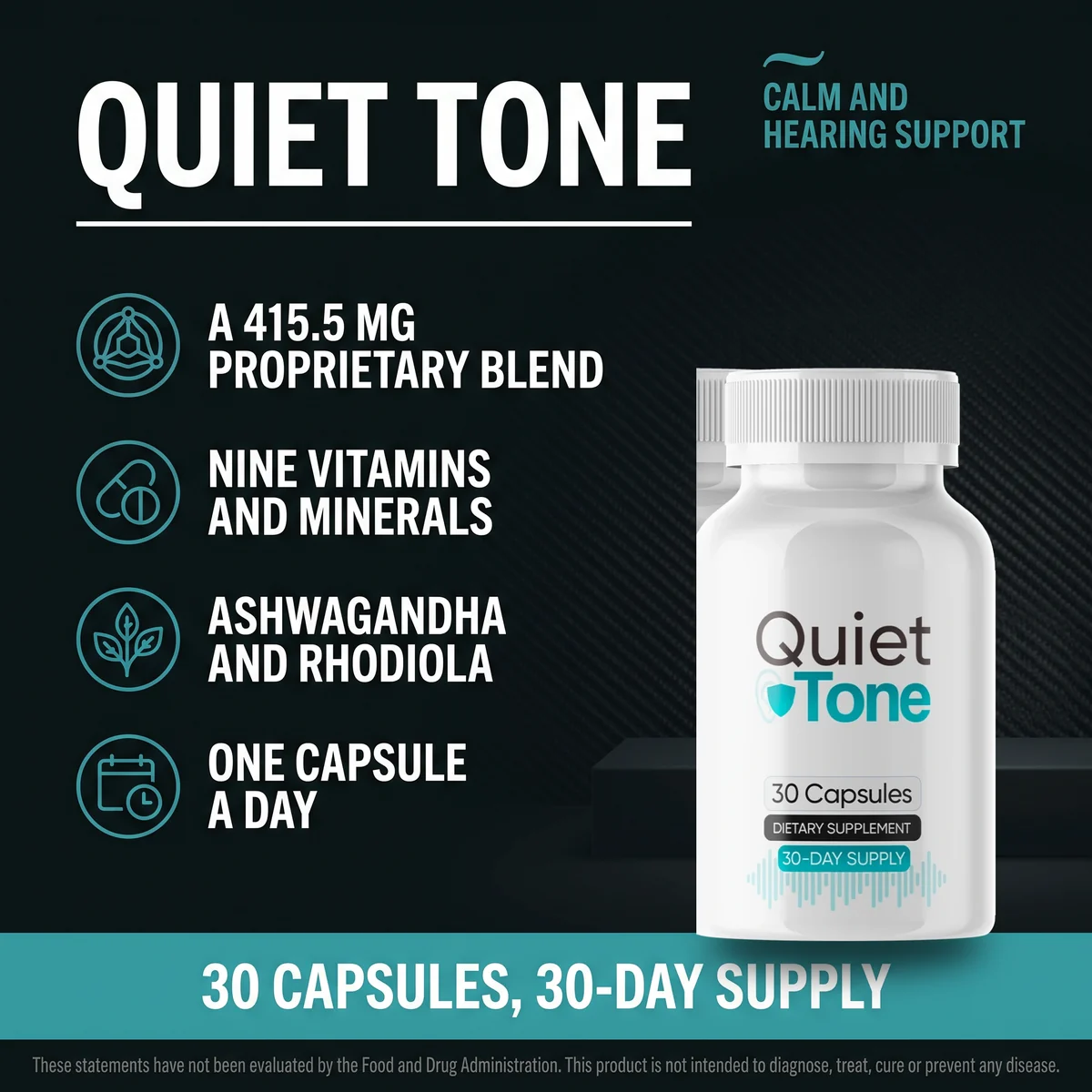
QuietTone pairs nine vitamins and minerals with a disclosed 415.5 mg botanical blend of ashwagandha, rhodiola, chamomile, lemon balm, GABA and L-theanine — one capsule a day, full panel published. The six-bottle bundle is the best value at $49 per bottle, with free U.S. shipping and a 60-day guarantee.
Check today's QuietTone pricing — from $49/bottleHow does QuietTone present ashwagandha honestly?
QuietTone treats ashwagandha as one supporting botanical in a disclosed blend rather than a miracle headline, which is the honest way to frame the evidence. Ashwagandha appears alongside rhodiola, chamomile, lemon balm, GABA and L-theanine inside a published 415.5 mg botanical blend, positioned for everyday calm and hearing wellness — not as a cure for tinnitus, anxiety or any diagnosis. The full supplement facts panel is published so you can see the blend total and the ingredient order for yourself, and the language throughout describes ashwagandha as traditionally used rather than clinically proven to treat anything.
How does it compare with other botanicals in the formula?
Ashwagandha is not the whole story, and honest framing means saying so. Rhodiola is another adaptogen with its own small evidence base, while chamomile, lemon balm, GABA and L-theanine each contribute to the everyday-calm angle. Our companion guides on ashwagandha versus rhodiola and the best nutrients for hearing and calm compare them side by side, and the homepage lays out the full ingredients section.
Is ashwagandha effective for everyone? A reality check
Ashwagandha is not effective for everyone, and the honest reality check is that individual response varies widely. In trials the average benefit is modest, so some people notice a calmer, better-slept baseline within a few weeks while others feel little difference. Effect also depends on your starting point: adults under real, ongoing stress tend to show the clearest change, while already-calm people have less room to improve. A supplement supports a routine of sleep, movement and lower stress; it does not replace one.
When should you talk to a doctor first?
Ashwagandha is generally well tolerated for short-term use in healthy adults, but it is not right for everyone. Skip it or check with a clinician first if you are pregnant or nursing, under 18, or taking thyroid, sedative, immunosuppressant or blood-sugar medication, because ashwagandha can interact with all of these. Rare liver-related reactions have also been reported, so stop and seek advice if you notice unusual fatigue, yellowing skin or dark urine. A quick conversation with your own doctor ensures it fits safely alongside your care.
Frequently asked questions
Does ashwagandha really work?
For everyday stress and sleep quality, controlled trials of standardised ashwagandha root extract report modest, real benefits over placebo. The evidence is strongest for perceived stress and calm, weaker and more preliminary for most other claims, and it does not show that ashwagandha treats, cures or prevents any disease.
What is the strongest evidence for ashwagandha?
The most consistent human data is for reductions in self-reported stress and improvements in sleep quality, seen in several small-to-medium randomised trials using standardised root extracts. Reviews by NCCIH and summaries on Examine.com describe this evidence as promising but limited by short study lengths and small sample sizes.
How much ashwagandha do studies actually use?
Most positive trials used roughly 250 to 600 mg per day of a standardised root extract, often split into one or two doses, for six to twelve weeks. A dose buried inside a proprietary blend may or may not reach that studied range, which is why blend transparency matters when you compare products.
Does a proprietary blend hide the ashwagandha dose?
A proprietary blend lists a single combined milligram total for several ingredients rather than the amount of each one, so you cannot confirm exactly how much ashwagandha it contains. It is legal and common, but it means you should judge the blend by its total, its ingredient order and the manufacturer's transparency rather than assume a studied dose.
How does QuietTone present its ashwagandha honestly?
QuietTone lists ashwagandha as part of a disclosed 415.5 mg botanical blend alongside rhodiola, chamomile, lemon balm, GABA and L-theanine, positions it for everyday calm rather than as a cure, and publishes its full supplement facts panel so you can see the total and the ingredient order for yourself.
Is ashwagandha safe for everyone?
Short-term use is generally well tolerated in healthy adults, but ashwagandha is not recommended if you are pregnant or nursing, and it may interact with thyroid, sedative, immunosuppressant or blood-sugar medication. Rare liver-related reports mean anyone with a medical condition or on medication should talk to a doctor first.
Check today's QuietTone pricing risk-free for 60 days →
QuietTone is a dietary supplement, not a treatment for any medical condition. These statements have not been evaluated by the Food and Drug Administration. This product is not intended to diagnose, treat, cure or prevent any disease. Always consult a qualified healthcare professional about your individual needs.
References & further reading
- National Center for Complementary and Integrative Health (NCCIH). Ashwagandha. nccih.nih.gov/health/ashwagandha
- Della Porta M, et al. Effects of Withania somnifera on cortisol levels in stressed human subjects: a systematic review. Nutrients, 2023. PMID 38140274
- Cheah KL, et al. Effect of ashwagandha (Withania somnifera) extract on sleep: a systematic review and meta-analysis. PLoS ONE, 2021. PMID 34559859
- Examine.com. Ashwagandha — evidence-based summary and dosing. examine.com/supplements/ashwagandha
- National Institutes of Health, LiverTox / MedlinePlus. Ashwagandha — safety and drug interactions. medlineplus.gov/druginfo/natural/953.html
These references describe ashwagandha and the habits around it in general terms and do not constitute evidence that any product treats, cures or prevents any condition.
Keep reading: ashwagandha in QuietTone for calm and hearing · ashwagandha vs rhodiola · back to the QuietTone blog · the QuietTone review.